Origin: An illuminating look at Indigenous peoples and their connection to the natural world Book Review for Read Your World Day 2026
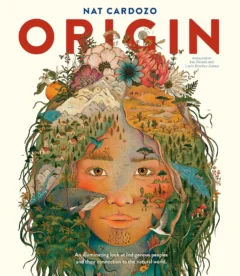
Origin: An illuminating look at Indigenous peoples and their connection to the natural world
Written and illustrated by Nat Cardozo
Translated by Ian Farnes and Layla Benitez-James
Red Comet Press, 2025
Reviewed by Eve Panzer, Barefoot Librarian
Read Your World Day 2026
Origin is a highly innovative and thought-provoking book, beautifully and lyrically written and gorgeously and creatively illustrated. The stories of little-known Indigenous peoples around the world are told through the eyes of youthful members of these communities. Their stories reflect their people’s care for and connection to the nature that surrounds and supports them, as well as details about their communities. It is an extraordinary, layered book with an essential and profound message about humankind and nature.
Each Indigenous group introduced in the book has a double-page spread. On the right side is an illustration of a child’s face, overlaid with elements of the habitat where they dwell. The left side contains text in a child’s voice, sharing unique stories, customs, beliefs, and other cultural elements of their people. This includes the foods they eat, hunting and farming techniques, housing, religious beliefs, clothing, coming-of-age rituals, and community organization and structure. There is often a description of the environment in which they live – deserts, forests, plains, mountains, etc., and how their people have adapted their ways of life to them. Each voice is singular and alternates between male and female.
The author conveys a great deal of information and emotion so poetically in a few short paragraphs. Each word has been expertly crafted. The lyrical language becomes even more impressive when you realize that the book was translated from Spanish! The author is also the illustrator, and, again, their talent shines. Each picture of the children’s faces superbly captures the essence of each child as well as the natural elements of the land they inhabit.
Today, we are witnessing the degradation of the Earth by what the book calls “consumerist societies,” which exploit natural resources for money. In contrast, Indigenous people “…live in a place in a way that doesn’t affect the fate of those other beings who inhabit it or cause the environmental degradation that exploitation produces.” These two groups have been in conflict for centuries, and the Indigenous people have been losing their land through acquisition or degradation. Because of this, their way of life, customs, and language are being taken away and lost. This book shows us that we can learn much from Indigenous peoples about their respect for our earth. They know how to take what they need from the land, but also how to give back and care for it so it continues to sustain them.
The endnotes include a map of the world showing the locations of the Indigenous people included in the book. It contains sections on “History and Territories”, “Threats and Resistance”, “Environmental Degradation”, and “Organization and Ancestral Knowledge.” The last page, “From Where You Are…”, is a message from an Indigenous child to children of the modern world. “You are part of this world, and the world is part of you.” “Self-respect also involves respecting what surrounds us: nature, the ecosystem, the atmosphere, the earth, our resources, and other human beings.” “Perhaps it is time to remember that nature lives inside each of us and we all come from the same ORIGIN.”
This is an essential book for every library, educator, and family! Very highly recommended!
Thank you to Angus Yuen-Killick and Red Comet Press for providing me with a copy of this stunning book to review.


